Introduction
This dissertation develops a calculus for the dynamics of strategic information flow.
No one knows much. In life, we only see a corner of the world, and we see beyond it by watching what others say or do. With each of us knowing so little, it is surprising that an economy can function at all.
No one person knows everything needed to make a pencil, yet pencils manage to exist, costing almost nothing. Leonard Read’s essay “I, Pencil” [98] traced the paths of cedar, graphite, lacquer, and rubber across the world to loggers, miners, and chemists who know nothing of each other’s work. Why would any of these strangers bother? How would any of them know what to make, and how much?
Adam Smith answered the first question with decentralized exchange: people pursuing their own interests could coordinate without anyone directing the whole [107], with competition keeping anyone from steering it. In competitive markets where many people can offer the same thing, no one has much power over the price, and excess profits are competed away. Prices emerged from the exchange itself, set by no one.
Friedrich Hayek, writing “The Use of Knowledge in Society” at the end of the socialist calculation debate, answered the second [53]. The debate asked whether a planning board could replicate market outcomes by solving the economy’s equations, and Hayek switched perspectives: the relevant knowledge, of the particular circumstances of time and place, exists only in dispersed fragments in countless minds, and no board could collect it. Prices, for Hayek, were a telecommunications system. The logger never sees beyond their own corner; the prices that reach them carry what the rest of the world needs them to know.
Prices may be useful for communication, but they must come from somewhere. Consider buying a car from a used-car salesman. The seller knows more about the car than you do [2]. But why should their knowing more cost you anything? You pay what you believe the car is worth, but the seller shapes what you learn. The same problem appears whenever actions both do things and signal, and formalizing that is hard.
The first obstacle was defining equilibrium under private information at all, which Harsanyi solved through priors over player types [52]. Muth proposed that players hold rational expectations consistent with the beliefs the model implies [87]. In macroeconomics, the reasons to do so became visible in the Phillips curve. Inflation and unemployment had been stably related [96] for long enough that the relationship was treated as a policy lever [102], and that relationship changed once it was used. Lucas explained the change using Phelps’s economy of islands [77, 95]. Isolated on each island, producers could not tell a general price rise due to inflation apart from a real movement in their own market and had to respond the same way to both, producing the correlation. Once the government began using inflation to manage unemployment, however, a price rise said less about conditions on the producer’s island and more about government policy. Producers therefore no longer responded to price increases in the same way, and at the macro scale that showed up as a shift in the Phillips curve.
The idea rebuilt the field. Following Lucas’s critique [79], relationships in economic data were no longer treated as potential levers to pull or equations to solve, but as features a model had to derive. Unfortunately, at the time, the lesson was applied mainly to the government, the one actor considered large enough for the effect to matter. In Lucas’s models, private agents remained price takers whose actions move nothing observed by others.
A few years later, Grossman and Stiglitz carried Lucas’s signal-extraction logic into asset markets and asked if prices could reveal everything traders know [47]. They cannot. If the price revealed everything, then gathering information would earn nothing, so nobody would pay to gather it. The invisible hand of the market could never reveal everything traders know.
Townsend later studied firms watching prices that reflect other firms’ actions [109]. Actions came from beliefs, so each firm had to predict what other firms believed. Those firms did the same, so to determine their actions, those beliefs in turn had to include beliefs about others’ beliefs, and so on. To get a solvable model, Townsend assumed that all private information is revealed after a fixed number of periods, capping the chain at a fixed length.
Keynes mentioned the same recursion decades earlier in The General Theory through his “beauty contest” analogy [66]. Readers of a newspaper entered a contest to choose the six prettiest faces out of a hundred, but prettiest was decided by the entries of the readers. Winning meant anticipating not which faces were prettiest, but which faces everyone else expected everyone else to choose, with nothing grounding those choices in the quality of the faces themselves. Beauty contests today describe stock markets ignoring fundamentals.
The closest the literature came to a full formal model of strategic information flow was the Kyle line of models, which began in finance in the mid-1980s. Kyle modeled an insider who learned something about a stock’s future value and a market maker who sets the price after seeing only order flow muddied by uninformed participants [71]. Every trade the insider makes moves the price and shows the market maker part of what the insider knows. Like the islanders, the market maker cannot tell informed and uninformed orders apart, so the insider stays under the radar by trading slowly, and the information only enters the price over time. Kyle kept the core of the problem, but in a special case where it could all be solved, with one insider, informed once at the start of trading, and a competitive market maker whose belief is public through the price. When the finance community saw the whole problem in a solvable model, it pounced, and a generation of extensions followed [11, 13, 38, 56]. Extensions with several informed traders stayed solvable only under heavy symmetry, with every trader drawing a signal from the same distribution [23]. The tractable territory was treated as exhausted.
Over time, interest spilled into nearby approaches: mean-field limits, global games and beauty contests, information design. After a generation, students learn dispersed information through these ideas. Global games, for example, introduce private noise to select among equilibria; the same device has come to serve as a model of what dispersed private information does [5].
In the problems studied here, actions move the state of the system, the state generates observations, observations update beliefs. Beliefs complete the cycle by determining the actions that started it. A loop (Figure 1). There is also a chord, where an action can set what others observe directly. Every tractable approach beyond the Kyle line severs the loop somewhere, so a modeler’s options can be organized by the cut each makes. The cuts fall on the privacy of beliefs, on what actions can teach, on the weight of one player, on the flow from observations to beliefs, or on time itself.
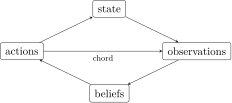
One option is to make private information public before the loop can keep running in private. Townsend reveals it after a finite number of periods, capping the hierarchy. Common-information methods do this with more finesse, pooling part of each player’s history into a shared record and often restricting beliefs to that shared information, so the loop never completes a lap in private [89, 92]. Hambly et al. [49], for instance, make actions completely observable and restrict to linear strategies, so that each action reveals the beliefs behind it and past beliefs become common knowledge after a single step.
Another option is to fix the information structure independently of play, as in Bayes correlated equilibrium [18], where actions respond to signals, but actions cannot change what other players learn. Another option is to take a mean-field limit [58, 73], so an individual player is too small to move the others’ states. Another option is to keep the network but remove the private-learning problem, cutting the flow from observations to beliefs [46].
Signaling and cheap talk are mostly studied in static settings, so the loop runs once [33, 108]. In cheap talk the message changes what others observe, not the state, keeping the chord and nothing else. In reputation models actions are public, so beliefs about the long-run player are common [69]. In sequential social learning each agent acts once, so nothing others learn ever flows back [15, 21]. Beauty-contest models keep Keynes’s recursion, but usually for one round and with the information structure fixed, so the loop runs once [5, 86]. Even information design, the subfield whose subject is what agents are allowed to observe, is studied mostly in static settings, so the loop runs once.
The two nearest neighbors sever the loop at its subtlest points. The frequency-domain solutions of the forecasting-the-forecasts literature [60, 64, 101] carry the belief hierarchy exactly, but only in stationary equilibria among negligible agents, so no individual action moves any signal and the edges out of actions are cut at the individual level. The insider-trading literature built on enlargement of filtrations [24, 29] keeps the chord and extends the Kyle line, but still for a single insider facing a market maker whose belief is public through the price, so the beliefs node carries no private tower. Expanding a filtration with an entire process, a dynamic endowment, is already hard on the purely probabilistic side [65].
Some tools must be taken out of their domain. Mean-field game theory, for instance, was built for a large anonymous population. However, the same limit has become a dominant way of handling dispersed information [4, 5, 76]. There a method designed for agents whose individual actions move nothing others observe gets applied to questions about what agents learn from one another.
Each approach removes a defining feature of dispersed information, restricting not just the questions that can be answered but the phenomena the model can produce. Approaches searching for tractability are often tempted by an elegant property of linear-quadratic-Gaussian (LQG) control known as the separation principle. A single controller can treat learning about the world and choosing its actions separately. When others are listening in on its behavior, actions become signals, and Townsend’s hierarchy applies. Separation fails unless something else is imposed.
Ask any model that claims to study the interaction between information flow and strategic incentives whether its results deliver a separation principle: whether, in the end, information and incentives can be treated separately. If so, the interaction it set out to study is absent, akin to a method that lets people study correlations between variables only when those correlations are zero. Cutting the loop often makes separation close to an assumption. If separation arises because information has been prevented from responding to incentives, then the model has achieved tractability by removing the mechanism of interest.
A journal cannot keep publishing papers that stop at saying the problem is hard. Individual papers are usually explicit about the assumptions they make, but what compounds are the results existing tools could reach. An outside modeler sees decades of work on private information, learning, signaling, prices, and strategic interaction, and naturally assumes that the underlying decentralized problem has already been studied, that what remains consists of technical refinements for specialists. They mistake the field’s principal results for the limits of what decentralized information can explain, but what looks like an economically exhausted subject might instead be a subject whose most expressive models have remained out of reach.
This dissertation is my attempt to allow the field to build the models it set out to build. I hope that the stories told through Hayek’s “The Use of Knowledge in Society” and Leonard Read’s “I, Pencil” can be put to paper more fully, and that I can someday enjoy reading the papers of a field that has kept its heart.
At a linear equilibrium, states, signals, and actions are linear functions of Gaussian shocks. Estimating an unknown then becomes a form of linear regression. The coefficients and the residual uncertainty depend on which sources a player watches, never on what those sources happened to say, so precision is common knowledge while estimates are not. Linearity also lets each player subtract the effect of their own actions from what they observe, so a player cannot manipulate themselves, only others. These two properties are both the sources of noise-state tractability and the limitations to what it can model. Economists already linearize to get tractable approximations to realistic models, but this has not been enough to handle decentralized information.
Art Moore, my linear algebra professor in community college, who inspired me to do this PhD, once explained the difference between ordinary and partial differential equations by saying that PDEs are so much harder to analyze because they can describe so much more. A language capable of describing complex phenomena necessarily carries some of that complexity in its own structure. My ambition for the dissertation’s central device, the noise-state, is to give economists a tractable way to write down that complexity. The resulting mathematics may be complex, but it is the simplest machinery I know that keeps the loop intact.
The noise-state
The noise-state is a recursive state for dynamic games with dispersed information. A player’s noise-state represents what that player believes about the underlying sources of uncertainty. To reason about other players, one also tracks how their beliefs about those same sources evolve; by necessity, those beliefs are themselves functions of the underlying sources of uncertainty. In the linear-quadratic-Gaussian case, the relevant updates become deterministic kernels, so equilibrium can be characterized as a fixed point and solved numerically.
Let be the primitive Brownian motion driving the state and the observation noises. Each player observes only their own signal, specified in each chapter; write for everything player knows when choosing at time . Define This is the player’s estimate, at time , of the primitive shock path that has already occurred.
Any process can be made Markov by declaring its whole history to be the state. What is needed is a Markov form that is stable under conditioning and best response. Say a process is linear if at each time it is a deterministic mean plus a deterministic impulse response kernel integrated against the primitive shocks, . The shocks’ path is a sufficient statistic for every linear process at once, however path-dependent. The primitive shocks, not the endogenous state, are the natural coordinates. Under perfect information every player reads these coordinates directly, and the kernels are the model’s ordinary impulse responses. Since each player observes those shocks through their own signals, the relevant statistic is the player’s belief about them: the noise-state. It changes what a belief is a belief about. Unlike higher-order beliefs about endogenous states, which are hard to close and unnatural to approximate, beliefs about primitive shocks are neither. By linearity everything can be written in terms of primitive shocks, including beliefs about them.
Common-information methods, introduced above, remove the tower the other way, by anchoring beliefs in information all players share. The loop can still survive, but the method buys tractability when what remains private is limited, usually alongside cuts made elsewhere. When most of the problem can be described through a shared state, the crux of the problem is not really in decentralization. Here signals are mostly private, so the shared state carries little. Each player instead builds coordinates inside their own filtration over the same primitive shocks.
Filtering reduces to a single deterministic object: the map from the primitive white noise to the player’s estimated white noise . Explicitly, a singular part plus a continuous density part with deterministic kernel , forming a blueprint for all the player’s beliefs. Here is an increment in the path index , rather than in the time of beliefs . Conditional on the player’s information, the shocks are Gaussian, with the noise-state providing the conditional mean and the blueprint determining the covariance.
The conditional expectation of a linear process is easy to represent. Write for . Conditioning changes the integrator and nothing else, , the same mean and the same kernel now run against the noise-state. In primitive coordinates the kernel becomes mixing the primitive shocks, and discretizing turns that composition into matrix multiplication. Taking an expectation of an expectation is no harder than an expectation of any other linear process, so the tower closes.
The unrestricted best response to a noise-state linear strategy is noise-state linear. A noise-state linear strategy is a linear process in the player’s noise-state rather than in the primitive shocks, The equilibrium problem becomes a deterministic fixed point in kernels.
The physical state and the players’ noise-states can be read as one enlarged state of the system, . Standard optimal control already prices movements of the physical state through a running shadow price, while the noise-state formulation adds a shadow price for moving another player’s noise-state, which I call the information wedge. It prices information externalities in both noncooperative and cooperative settings, such as in a team where a teammate acts to show the rest what they know. Every manipulation channel passes through it. It breaks separation, and vanishes whenever the loop is cut.
Stochastic games are typically posed as forward-backward systems whose backward equation includes a martingale-representation term. The conditional expectations and the shadow prices separate here because the forward equations, including those for the noise-state, are stochastic while the backward equations for the adjoints are deterministic ordinary differential equations.
Rational-expectations models describe today’s behavior and ask what happens to the propagation of shocks as policy rules change. Policy changes still require recomputing the equilibrium, in the Lucas sense, but the kernels being recomputed are already indexed by the primitive shocks. A researcher can take an existing model with perfect information, specify who sees what, and solve again in the same coordinates to see how impulse responses and means change.
The accompanying Python package, pypi.org/project/noisestate,
implements this workflow for supported finite-horizon and stationary LQG
games.
Chapter roadmap
Baseline. Chapter 1, which closely follows the preprint [10], builds the calculus in the finite-horizon LQG game. It develops the noise-state linear class, proves that filtering and best responses stay inside the class, and derives the adjoint system in which the information wedge prices what an action teaches the other players. A finite-deviation identity then verifies a computed equilibrium against every admissible deviation, including those outside the linear class. The small two-player example separates the statistical value of information from its strategic value and shows how a planner can deliberately starve an inefficient player by how it allocates signal precision. An identical-interest variant closes the chapter. Interactive versions of the dissertation’s computations are collected at sbabichenko.com/noisestate.
Delay. Chapter 2 lets news arrive late. Players may hear the same news after different delays, and what a player does can show up in a signal directly as well as through the state. Until the news arrives, a player can move what others believe; once it arrives, it explains the movement away, as when an insider’s trade is disclosed weeks after it moved the market. Delays usually make filtering messy, but here the delay adds terms to the same equations rather than requiring a different method.
Stationarity. Chapter 3 rewrites the baseline equations for a game that has run long enough to become stationary, so objects of the calculus become functions of ages rather than dates. The stationary formulation is also the easiest to compute. It lets us measure how closely a finite-dimensional system can approximate the equilibrium. It is a natural initial condition for studying a change of regime, and the setting of Chapter 4.
Trading. Chapter 4 applies the stationary equations to Kyle–Back trading on an infinite horizon. The chord ran through the earlier chapters without being leaned on; here it is the object of study, because order flow is both an action and a signal, so a marginal order moves the current price and changes future filtering by the market maker and the other informed traders. Each trader knows its own order and interprets the remaining flow differently, so the rivals’ responses make dynamic price impact trader-specific. In the computations, they can reverse a price move the market maker alone would leave permanent. This chapter keeps Kyle’s market, with several traders of heterogeneous signal quality and continuous signals. A specialist may trade first in a correlated market with more noise-trader flow.
Aggregation. Chapter 5 turns to economies made of many small local markets, each with only a few players: a regional credit market with a handful of lenders. Each player is negligible nationally but consequential locally, so the local game keeps the wedge while the economy stays large. Graph symmetry then collapses the player labels: policy, filtering, and belief-price kernels depend only on relative position, and equilibrium is solved once per position rather than once per player. The idiosyncratic shocks average out across markets but the incentives do not. In the cycle economy every firm holds back its order because its supplier reads demand off it, and the aggregate mean order sits below its perfect-information level. The results are for finite networks, with the infinite-network limit stated as a conjecture.
Monitoring. Chapter 6 makes the chord player-dependent. A deviation may be monitored by some players and not others. A privy player sees the deviation labeled with who made it and does not filter it, while a naive player keeps filtering it as more primitive shock. The feedback splits into a naive channel, which is the wedge, and a privy channel, in which the privy player responds to the deviation directly, and the adjoint becomes a rectangular gain between responder–origin pairs. The monitoring relation runs from the setting of Chapter 1, where no deviation is ever observed, to the classical closed-loop games in which every deviation is; both endpoints are recovered exactly (Proposition 6.13). Its worked example computes the same market under both relations: once the order flow is published the market maker puts more weight on inventory in its quote, because a trader who sees the flow can be steered, and most of transparency’s gain is real inventory efficiency.